The world we live in is causal, yet many Artificial Intellgience systems and most Machine Learning systems ignore this reality for the sake of convenience. There is a growing interest in making progress in this important concept, and this space will highlight our research in that area.
Our Papers on Causality
Modeling Soft Intervention Effects for Implicit Causal Representation Learning
Machine Learning.
115,
(199).
Springer Nature,
Aug,
2026.
Learning causal representations from data without access to ground-truth causal graphs remains a central challenge in representation learning. Implicit approaches—where the model learns causal dependencies without explicitly parameterizing the causal graph—offer a compelling advantage over explicit methods by avoiding optimization difficulties such as local minima associated with adjacency matrix estimation. However, existing implicit methods often assume access to hard interventions, which are rarely feasible in real-world scenarios. In contrast, soft interventions—more prevalent in practice—modify causal mechanisms without severing parental dependencies, introducing subtle, ambiguous effects that confound learning. To address this, we propose ICRL-SM, a novel method for Implicit Causal Representation Learning from soft interventions using a causal mechanism switch variable. This variable captures unwanted changes induced by soft interventions, enabling the model to focus on the necessary variations that reflect underlying causal structure. Our framework leverages a variational autoencoder trained on paired pre- and post-intervention samples, and is theoretically grounded under a set of assumptions that ensure identifiability of causal representations. Although some assumptions (e.g., Gaussianity of latent variables, diffeomorphic decoders) are strict, we show empirically that our method performs robustly even when these are violated—demonstrating strong results on both synthetic benchmarks and real-world image datasets. These findings highlight the potential of ICRL-SM to bridge the gap between theoretical identifiability and practical applicability, advancing causal representation learning under realistic conditions. The source code for this paper is available at: https://github.com/sshirahmad/ICRL.
Generative Causal Representation Learning for Out-of-Distribution Motion Forecasting
In
Proceedings of the 40th International Conference on Machine Learning (ICML).
PMLR,
Honolulu, Hawaii, USA.
Jul,
2023.
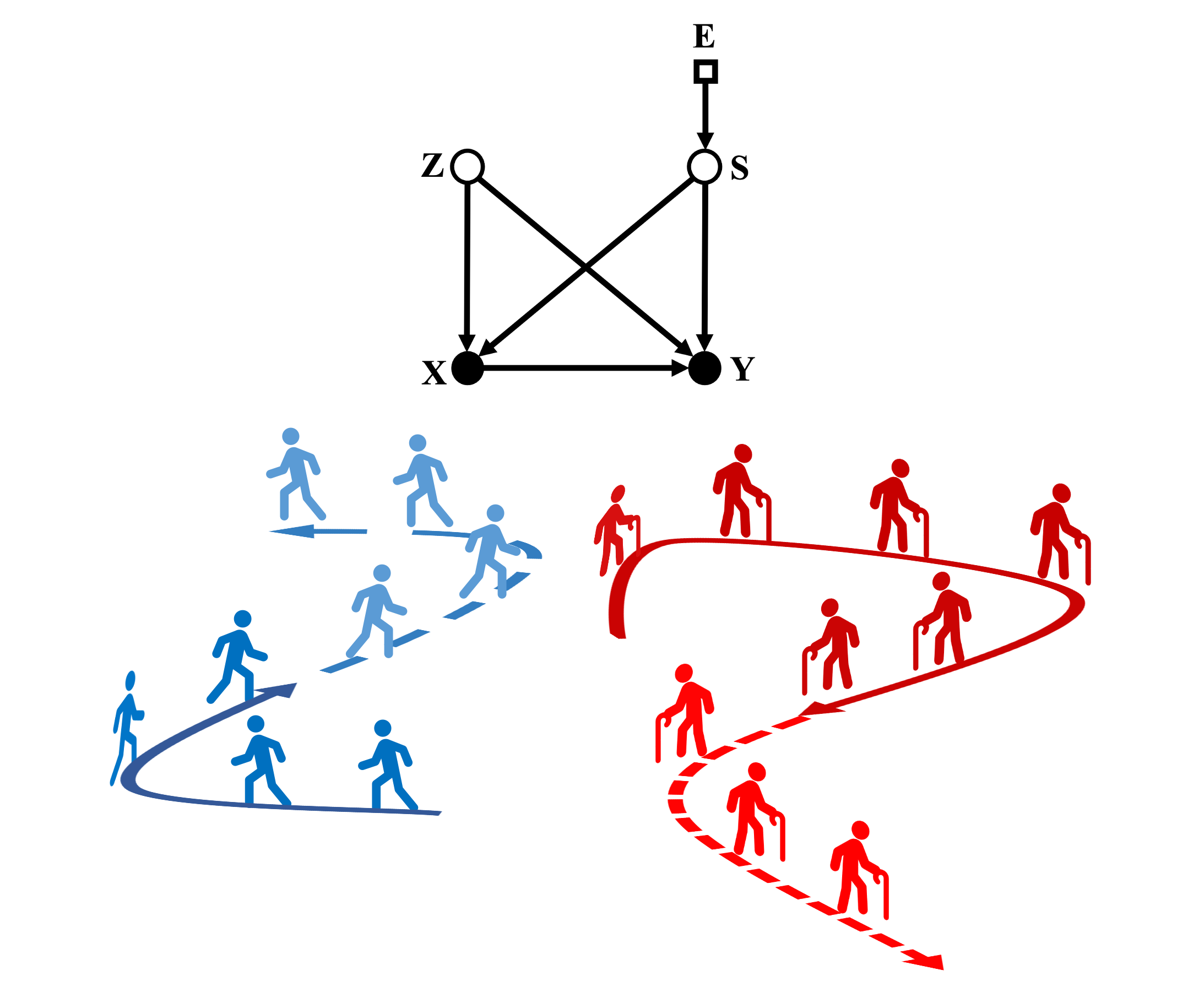
Conventional supervised learning methods typically assume i.i.d samples and are found to be sensitive to out-of-distribution (OOD) data. We propose Generative Causal Representation Learning (GCRL) which leverages causality to facilitate knowledge transfer under distribution shifts. While we evaluate the effectiveness of our proposed method in human trajectory prediction models, GCRL can be applied to other domains as well. First, we propose a novel causal model that explains the generative factors in motion forecasting datasets using features that are common across all environments and with features that are specific to each environment. Selection variables are used to determine which parts of the model can be directly transferred to a new environment without fine-tuning. Second, we propose an end-to-end variational learning paradigm to learn the causal mechanisms that generate observations from features. GCRL is supported by strong theoretical results that imply identifiability of the causal model under certain assumptions. Experimental results on synthetic and real-world motion forecasting datasets show the robustness and effectiveness of our proposed method for knowledge transfer under zero-shot and low-shot settings by substantially outperforming the prior motion forecasting models on out-of-distribution prediction.
Cyclic causal models with discrete variables: Markov chain equilibrium semantics and sample ordering
In
International Joint Conference on Artificial Intelligence (IJCAI).
Beijing, China.
2013.
We analyze the foundations of cyclic causal models for discrete variables, and compare structural equation models (SEMs) to an alternative semantics as the equilibrium (stationary) distribution of a Markov chain. We show under general conditions, discrete cyclic SEMs cannot have independent noise, even in the simplest case, cyclic structural equation models imply constraints on the noise. We give a formalization of an alternative Markov chain equilibrium semantics which requires not only the causal graph, but also a sample order. We show how the resulting equilibrium is a function of the sample ordering, both theoretically and empirically.